Introduction to ISO 42001 & AI Management Systems
Foundation of ISO/IEC 42001:2023, what an AI Management System (AIMS) is, why organizations need it, and certification benefits.
Chapter Overview
This chapter introduces ISO/IEC 42001:2023, the world's first international standard for AI Management Systems. You'll learn what AIMS is, why it matters, who should implement it, and how certification works.
What is ISO/IEC 42001:2023?
ISO/IEC 42001:2023 is an international standard specifying requirements for establishing, implementing, maintaining, and continually improving an AI Management System (AIMS). Published in December 2023, it represents a landmark achievement in AI governance.
Full Title: ISO/IEC 42001:2023 - Information technology — Artificial intelligence — Management system
Published: December 2023
Developed By: ISO/IEC JTC 1/SC 42 (Artificial Intelligence)
Type: Management System Standard (Certifiable)
Structure: Based on Annex SL Harmonized Structure
Purpose of the Standard
The standard helps organizations:
- Govern AI responsibly through policies, processes, and controls
- Manage AI-related risks throughout the AI system lifecycle
- Ensure ethical AI use aligned with organizational values
- Demonstrate compliance to regulators and stakeholders
- Enable innovation within structured governance
What is an AI Management System (AIMS)?
An AI Management System (AIMS) is a set of interrelated elements used to establish policies, objectives, and processes for responsible development, provision, or use of AI systems.
AI Policy: High-level governance statement
Objectives: Measurable AI governance goals
Processes: Procedures for managing AI lifecycle
Roles & Responsibilities: Clear accountability structure
Risk Management: Systematic AI risk approach
Controls: Safeguards for AI requirements
Monitoring: Ongoing effectiveness evaluation
Continual Improvement: Enhancement mechanisms
AIMS vs Traditional Management Systems
| Traditional MS Focus | AIMS Additional Focus |
|---|---|
| Information security | AI-specific risks (bias, explainability) |
| Quality of products | AI system performance and reliability |
| Environmental impact | Societal and individual AI impacts |
| Process compliance | AI lifecycle management |
| Documentation | AI transparency and explainability |
Why Do Organizations Need AIMS?
The AI Governance Challenge
- Complexity: AI systems are often opaque
- Rapid Evolution: Technology changes faster than governance
- Risk Diversity: Novel risks (bias, hallucination, autonomy)
- Regulatory Pressure: Global AI regulations emerging
- Stakeholder Expectations: Demand for responsible AI
- Accountability Gap: Unclear responsibility when AI causes harm
Regulatory Compliance: Meet EU AI Act, sector regulations
Risk Reduction: Systematically mitigate AI risks
Competitive Advantage: Demonstrate AI trustworthiness
Operational Efficiency: Standardize AI processes
Innovation Enablement: Guardrails for experimentation
Reputation Protection: Prevent damaging AI incidents
Who Should Implement ISO 42001?
Applicability
ISO 42001 applies to any organization that:
- Develops AI systems
- Provides AI-based products or services
- Uses AI systems
- Integrates AI components into larger systems
| Organization Type | Implementation Focus |
|---|---|
| AI Developers/Vendors | Full lifecycle controls |
| AI Service Providers | Service delivery, transparency |
| Enterprise AI Users | Risk management, oversight |
| Regulated Industries | Compliance demonstration |
| Government/Public Sector | Ethical AI, transparency |
Benefits of ISO 42001 Certification
Internal Benefits
- Structured governance with clear policies
- Systematic risk visibility and management
- Operational consistency across AI initiatives
- Documented knowledge management
- Organization-wide responsible AI culture
External Benefits
- Market differentiation through demonstrated commitment
- Third-party validated AI trustworthiness
- Regulatory readiness for emerging laws
- Partnership enablement for supply chains
- Investor assurance on AI risk management
Certification Process Overview
| Phase | Duration | Focus |
|---|---|---|
| Preparation | 6-18 months | AIMS implementation |
| Stage 1 Audit | 1-2 days | Documentation review |
| Gap Closure | 1-3 months | Address findings |
| Stage 2 Audit | 2-5 days | Full assessment |
| Certification | - | Certificate issued (3-year) |
| Surveillance | Annual | Ongoing verification |
| Recertification | Every 3 years | Full reassessment |
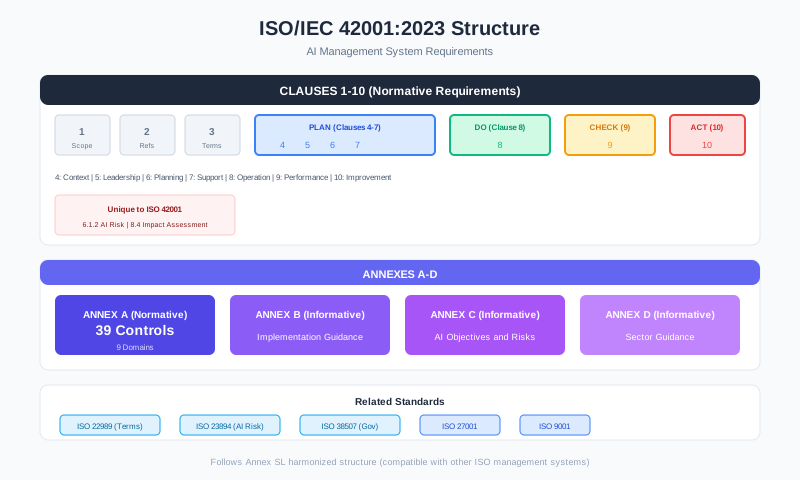
ISO 42001 Structure Overview
Main Clauses (1-10)
| Clause | Title | Focus |
|---|---|---|
| 1 | Scope | Applicability |
| 2 | Normative References | Referenced documents |
| 3 | Terms and Definitions | Terminology |
| 4 | Context of Organization | Understanding context |
| 5 | Leadership | Commitment and policy |
| 6 | Planning | Risk and objectives |
| 7 | Support | Resources and competence |
| 8 | Operation | AI lifecycle, impact |
| 9 | Performance Evaluation | Audit, review |
| 10 | Improvement | Corrective action |
Annexes
| Annex | Title | Type |
|---|---|---|
| A | Control Objectives and Controls | Normative (39 controls) |
| B | Implementation Guidance | Informative |
| C | AI Objectives and Risk Sources | Informative |
| D | Sector Guidance | Informative |
1. ISO 42001 is the first international AI Management System standard
2. AIMS provides structured governance for AI development, provision, and use
3. Certification demonstrates commitment to responsible AI
4. Applicability extends to developers, providers, and users of AI
5. Structure follows Annex SL, enabling integration with ISO 27001/9001
6. 39 controls in Annex A provide specific AI governance requirements
• Understand difference between AIMS and traditional management systems
• Know certification process phases (Stage 1, Stage 2, Surveillance)
• Remember ISO 42001 applies to development, provision, AND use
• Be familiar with Annex structure (A=Controls, B=Guidance, C=Risks, D=Sectors)